The Snow in Black and White

Well, it snowed AGAIN in Tokyo this weekend! (Miracles DO happen!)
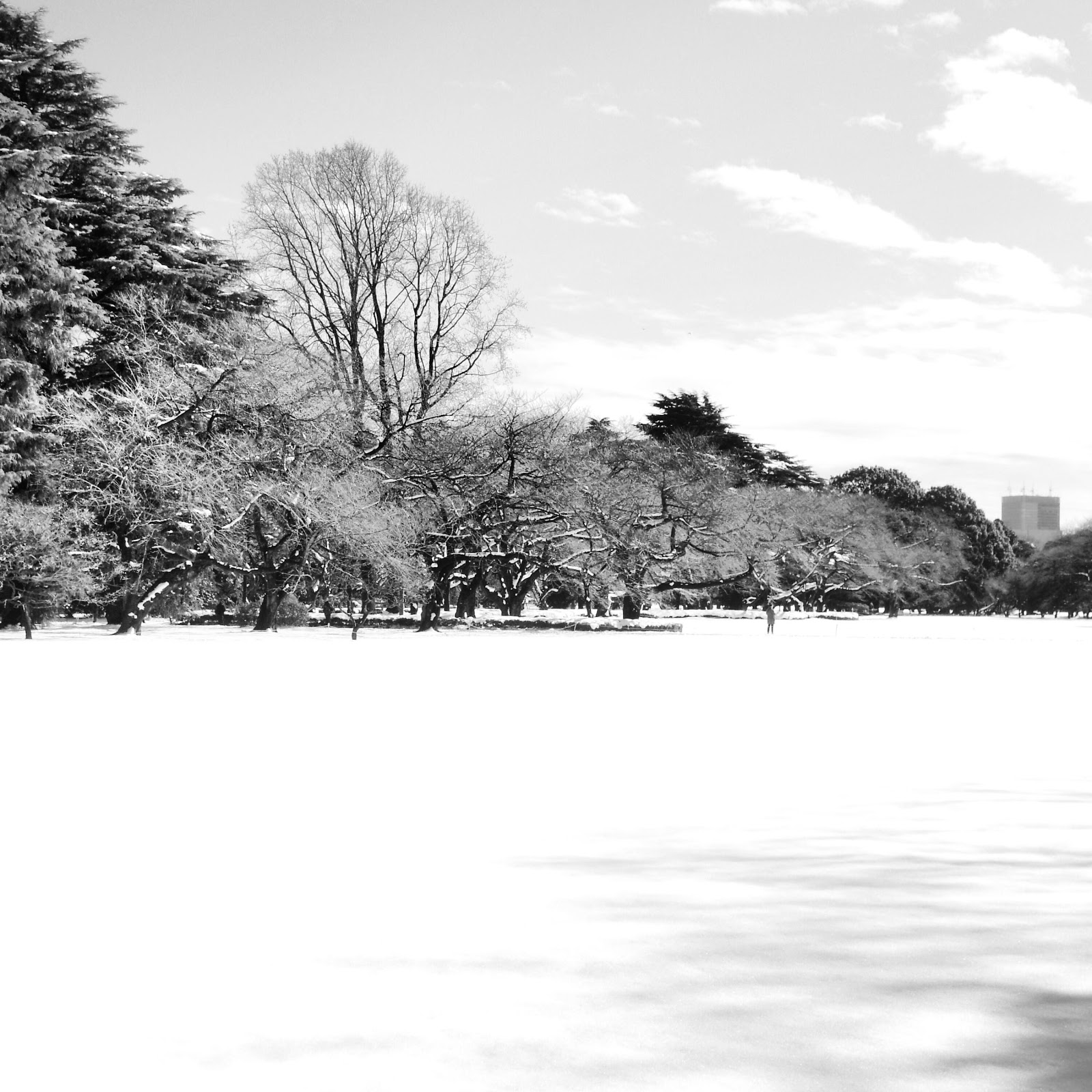
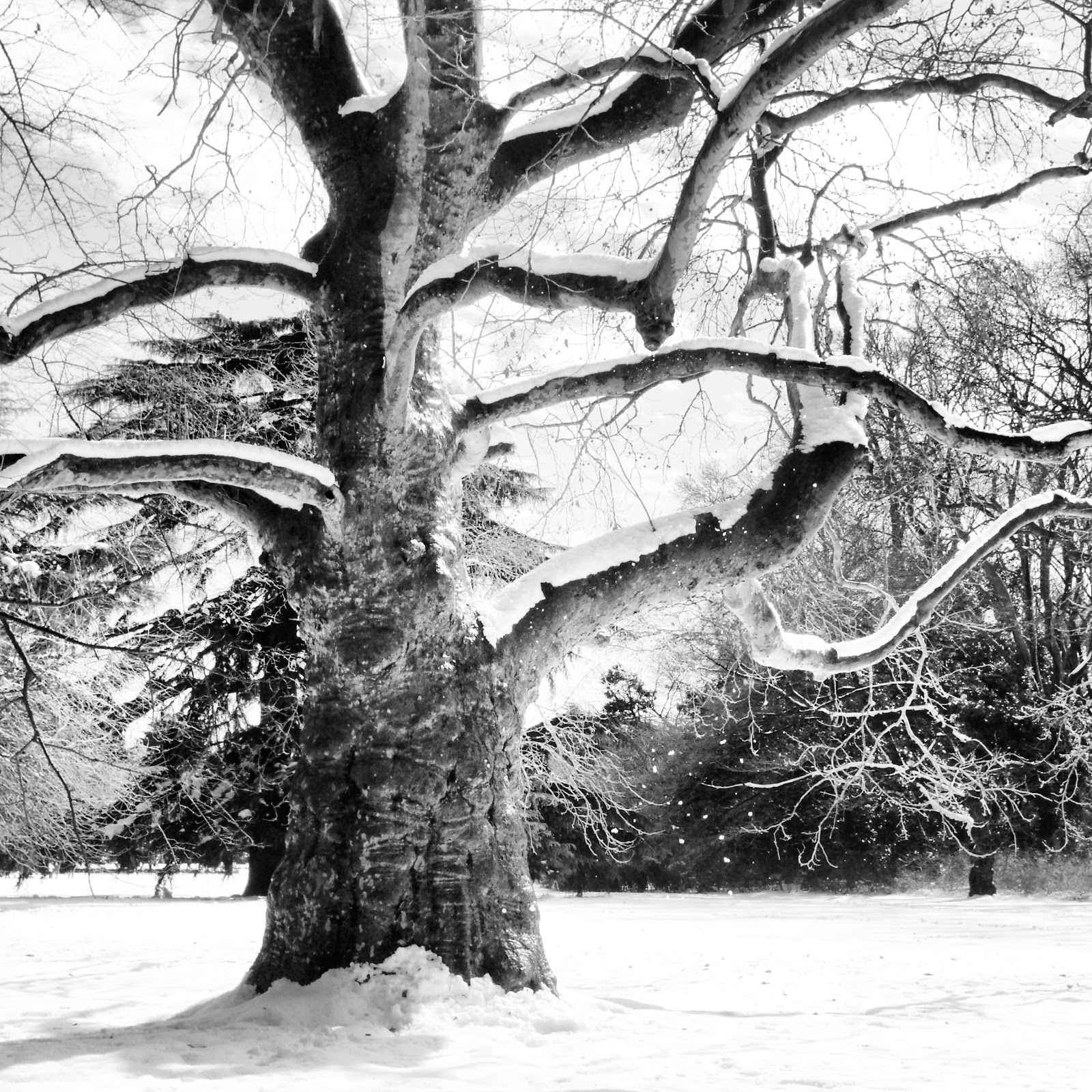
So naturally, I took this to mean that I can post even more snow photos here! But just to keep things from getting stale, I decided to post black and white photos so it wouldn’t just be another snow post…it would be the black and white snow post! Ha.
I took most of these photos while walking through Shinjuku on my way to meet a friend in Shibuya. The view from the Tokyo Metropolitan Government Building was an ocean of white. How amazing is that? It’s not a view we see too often in Tokyo. I also stopped by Shinjuku Gyoen and had a hard time resisting the urge to make snow angels. And you can see in one of the photos but the lake in the park had frozen over!
Don’t you love how quiet it gets right after a snow fall? x
Here are some photos:

The Bookstores in Jimbocho

Jimbocho is famous for their used bookstores. 
There are rows and rows of books, both inside and outside of the stores, just waiting for someone to come pick them up. So many different genres can be found in an array of colors and sizes. It’s really a kind of organized chaos of books. I love it.
Jimbocho (神保町) is a corner of Tokyo, located in Chiyoda ward, and it has a very interesting history with books. There’s said to be approximately 180 used bookstores in the Jimbocho area.
During the Edo era, many samurai residences, or buke-yashiki (武家屋敷), were located around this area. After the Meiji Ishin (明治維新), when the Tokugawa shogunate crumbled, many of the lords and vassals who resided in this area moved back home or headed to Shizuoka with Tokugawa Keiki (徳川慶喜), and a large part of this area was left vacant.
When the new government started, not only was this area a residence for new officials, but many schools and hospitals were built in the large vacant areas as well. Many well-known schools such as University of Tokyo, Gakushuin University, Juntendo University, Meiji University, Chuo University were first established in this area during the Meiji era. Because there were so many schools located here, inevitably the number of professors, students, and researchers in the area increased, along with the need for books. And as students tend to be poor in any day and age, the need for used books also increased!
So that was apparently the start of Jimbocho’s affiliation with books. The Jimbocho area has seen its share of difficult times, from the Great Kanto Earthquake in 1923, which burned down the entire area, to during the war, when food was scarce. But each time the bookstores got back on their feet in search of books to sell in their store.
It had been awhile since I’d been to Jimbocho and, even though I didn’t buy anything, it was a great way to spend the afternoon. I poked my nose into a lot of bookstores. My favorites were the used bookstore with design/art books, old old old Japanese calligraphy books, and the one with classic English books. But there were too many to see at once so I want to drop by again. And hopefully next time, I’ll be able to make up my mind about which book I want to take home with me this time!
Here are some photos:

The Afternoon at Arms Burger Shop

I completely forgot about these photos!
My high school friend has the cutest dog (seen here before) and sometimes we go to Yoyogi Park to let him roam and run wherever he pleases. We also like to stop by this little burger shop Arms because they allow dogs inside with you. It’s the perfect nook to warm up and relax in.
Here are some photos of the tiny but ferocious (not really) Leo and his people:

The Day It Snowed In Tokyo

I know, I know. Everyone is tired of seeing snow photos from Tokyo.
But I can’t help it. I love love love snow. I dislike winter (with a passion), but snow makes the cold, the dry air, the shorter days all worth it. I was telling a friend yesterday that everyone needs snow in their lives. They really do.
I was born in Okinawa and it never snows there. My grandma, who still lives in Okinawa, actually called me this weekend to make sure I hadn’t fallen on ice and cracked my head open or gotten buried under all the snow. I love her. She mentioned this winter was a cold one for Japan and that temperatures even fell to 18C in Okinawa yesterday…I had to tell her that sounded like paradise 😀
Anyways, I don’t remember the very first time I saw snow but my parents tell me that my sister and I were outside playing in the snow EVERY SINGLE DAY. Pretty sure it’s true because I have a lot of memories of us (and photos, of course) playing in the snow (like here and here). Snow was magical to us. And in Tokyo, where it snows only once a year, if at all, it still hasn’t lost its magic for me!
Here are some snow photos:

The Hatsumode in Kurashiki

There is nothing quite like walking around town wearing a kimono.

I’m not quite sure why it feels so great. Maybe because I don’t wear it regularly so the occasion feels special. Or maybe because it wraps beautifully around a woman, especially one with no butt and no boobs. Either way, I love it and never pass up an opportunity to wear one.

During our new years holiday in Ehime, my sister and I decided to stop by Kurashiki (倉敷), a small town in Okayama prefecture, before heading back home to Tokyo. And because Hatsumode (the first visit to a shrine or temple in the new year) is a special occasion, we decided to get dressed up!

The process of putting on the kimono is called Kitsuke in Japanese.
We rented the kimono for the afternoon at Kurashiki Kimono Komachi.
So many beautiful stores are located within Kurashiki’s historical quarter.
The official flower of Kurashiki is Fuji (Japanese Wisteria).
Okayama prefecture is famous for their Bizen-yaki pottery.
I thought the persimmons hanging from the naked tree above the torii was quaint.
For hatsumode, we went to Achi Shrine (阿智神社), a 1,700 year old shrine which sits atop Mount Tsurugata (鶴形山 tsurugata-yama). This mountain is located in the corner of the Kurashiki’s historical quarter and in the olden days it was an island surrounded by the waters of the Seto Inland Sea (瀬戸内海). For that reason, Munakata Sanjojin (宗像三女神), known as the three goddesses of the sea and voyages, is enshrined here.
Did I mention this was a mountain? Even though it was a little mountain, it was quite the challenge walking up all those steps in our kimonos. Literally an uphill battle. But Achi Shrine was not only beautiful itself but the grounds had an amazing view of the city of Kurashiki. So glad we went up there. 
I wasn’t counting how many steps we climbed but Achi Shrine apparently has a name for each set of steps. The first set has a total of eighty eight steps and is named Beiju hill (米寿坂). We call being eighty eight years old Beiju because the kanji for Bei (米) can be broken down to the kanji for eighty eight (八十八). The next set has a total of sixty one steps. It is called Kanreki hill (還暦坂). This comes from our Kanreki celebration in Japan when someone becomes sixty, which is considered sixty one in the traditional kazoe-doshi age system.
Finally the last set of stairs is thirty three steps, called Yakubarai hill (厄払坂) and it refers to the superstition of Yakudoshi (厄年), a year of bad luck, which is said to be the year a woman turns thirty three in the old age system. (The men have a different age for their Yakudoshi). This hits home because technically this year is my Yakudoshi (I turn thirty two this year…eek!).
I always think it’s interesting how many things have a deeper meaning in Japan, even the number of steps to climb up to a shrine. 
Here are some more pictures of Achi Shrine and Kurashiki:
The entrance to Achi Shrine was in full new years festive mode.
The Zuishin-mon (随神門) and the Yakubarai hill (厄払坂).
Many people writing out their prayers and wishes on the wooden Ema (絵馬).
Kimono photos in front of the main shrine.
The Ema (絵馬) at Achi Shrine reminded me of Black Beauty 🙂
So many different kinds of Omamori (お守り) to choose from!
My sister and I always pick up an Omikuji (御神籤), which tells your fortune.
Mine had many wise words for me, such as “health is very important.” So true.
Achi Shrine had a place for people to tie their Omikuji according to your year of birth!
My favorite view of the city below…so many lovely roofs.
Walking down Kanreki hill (還暦坂).
Old wooden buildings standing in the historical district.
I love new years decorations so much…I could start a blog.
We didn’t have time but the Ohara Museum of Art is on my list of places to visit next time!
Traditional hand towel shop….I didn’t trust myself to go inside.
Tiny new years decorations right outside of a shop entrance.
Various types of Okaki, a rice snack. We took forever to choose!
My sister ended up getting the red shiso flavor and I got the yuzu black pepper flavor. Yum!

My sister standing by the famous Kurashiki river.
We had such a great time in Kurashiki…already looking forward to going back this summer! 😀
The Results of Stress Baking

I’ve always liked the process of baking something.

But I’ve come to realize that I stress bake. I’m not even sure that’s an official word, but I tend to bake when I’m stressed. And because winter is not my best season, I’ve been baking like a maniac for the last month or so.

The good thing is, it always makes me feel better and I get something yummy to eat!

I think it’s the whole process of measuring, mixing, kneading, whisking. It’s a great stress reliever. Not to mention the aroma therapy of baked goods that fills my apartment once it’s in the oven.
What are some of the things you do to de-stress? And since winter is not yet over…do you have a good recipe of something for me to bake? 😀

The February Link Love

Happy February everyone! Are you ready for the shortest month of the year?

I don’t know if I am but I’m hoping to juggle everything a lot better than I did in January. The flu was making the rounds at work and a lot of us got sick last month, which messed with our heavy work load.

But this was one of the times I was grateful that I work in a typical Japanese company. We work in teams, so even if someone suddenly isn’t able to come into work, we can cover for them so the work doesn’t stall during their absence. It makes missing work a lot less stressful.

 I’m guessing February will be another crazy month. But I’m excited. My office will be in a new location starting this month (need to remember to go to the correct office on Monday morning!). Also, Valentine’s Day is serious business in Japan (as in my male coworkers will be expecting something from us on that day…apparently their status at home depends on it!). But nothing tops the fact that my best friend from college, who currently lives in Melbourne, will be coming to Tokyo for a visit. I can’t wait to see her and her fiance 😀

Will you be doing something for Valentine’s Day? Or anything else exciting planned?

I cannot tell you how relieved I am to see ume (plum) blossoms blooming here and there. Winter is coming to an end…FINALLY!!! I don’t care how itchy my eyes get from the pollen allergies (have I mentioned that they already started itching a few weeks ago?), I can’t WAIT for spring to get here. Longer days, more sunshine, and warmer temperatures…I’m counting down the days!

I hope you all are blessed with good health and have an amazing month in February! x

——————————————————-Link Love——————————————————-

– I love instagram but this reality behind instagram made me laugh out loud…so true sometimes.

Chalk art book covers are amazing.

– Wouldn’t these heart-shaped lemons be great for valentine’s day?

– Speaking of valentine’s day, I think I’m making this and this. Keeping it healthy this year!

– Pippi Longstocking animation film that was never made.

– Will you be watching the Olympics in Sochi? I’ll be following figure skating, ski, and this guy.

Andy Warhol’s exhibition in Roppongi.

The Kibitsu Shrine in Okayama

I’ll start this post with a warning…there are going to be a lot of photos!
On my way back home to Ehime via Okayama, I took a quick detour to Kibitsu Shrine (吉備津神社). It is located a quick walk from Kibitsu station on the Kibi Line, which is about 15 minutes from Okayama Station. As you can tell from the names, Kibi was an ancient province of Japan which is primarily the current Okayama prefecture and parts of Hiroshima, Kagawa, and Hyogo prefectures.
Kibitsu Shrine is a prominent shrine in the ancient Kibi province. The enshrined deity is Oh-kibitsuhiko-no-mikoto (大吉備津彦), who is said to have been a model for the Japanese folklore Momotaro (read long-version here or short-version here).
Other reasons many people stop by this shrine is to lay their eyes on the row of tall pine trees, which are the largest in Okayama prefecture, that lead you to the shrine entrance. They’ve been standing there since 1974 and I imagine they’ve seen many people pass under them.
Some come to take in the massive main shrine, which was rebuilt in 1425 during the Muromachi era. Let me tell you, it is ginormous. It doesn’t look like it when you are climbing the steps, but when you walk out to the open area to the side, you can see the unique hiyoku-irimoya-zukuri (比翼入母屋造) roof, which only this shrine has in Japan. 
So many things to see.
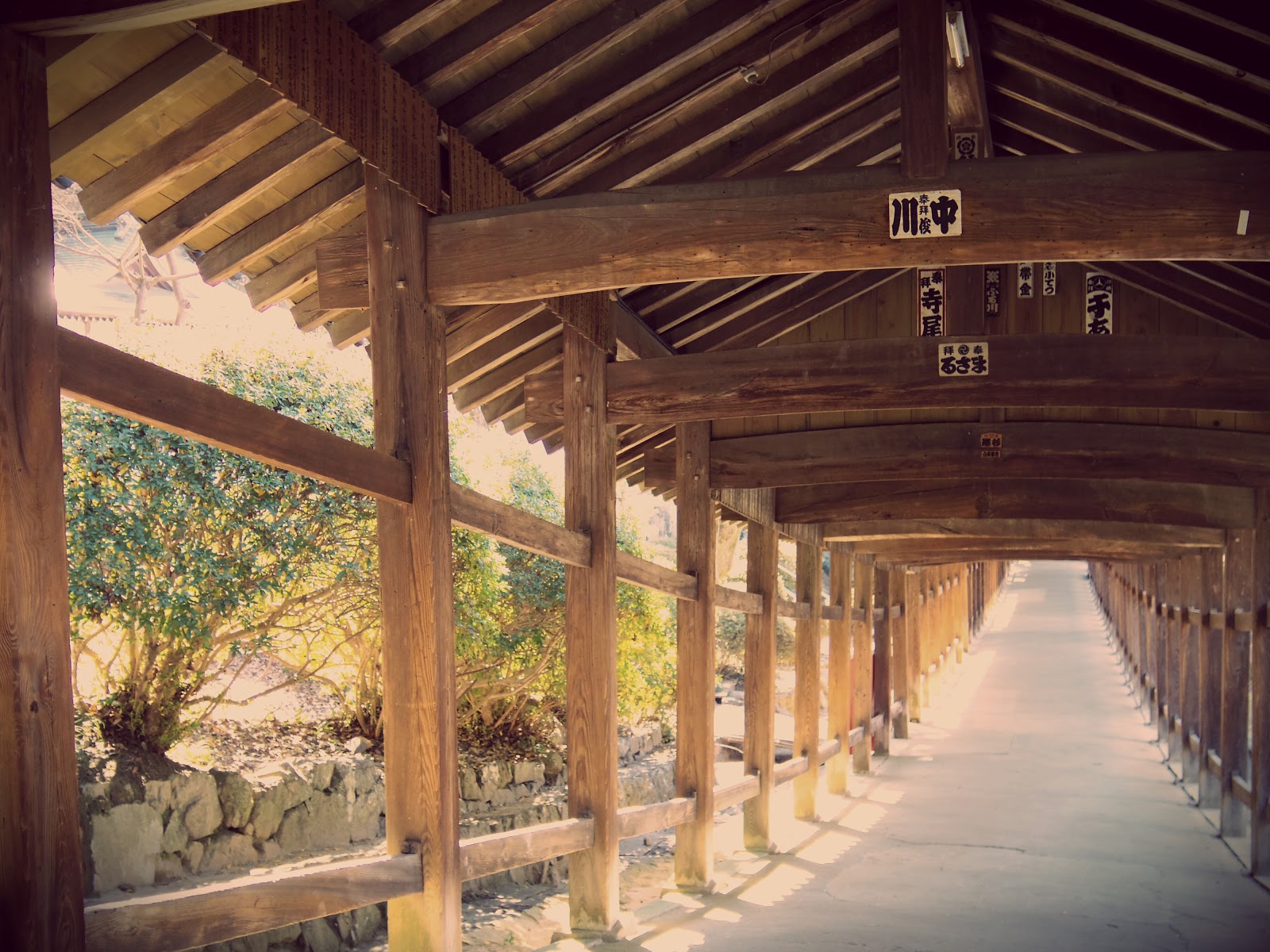
But I personally was there to take a walk down the long long corridor that leads from the main shrine to the gokuden (御供殿). It was built to fit the natural incline of the land and it is over 360 meters long. It was a beautiful corridor made of wood and it was a lovely spot to take a morning stroll. It was quiet because I was mostly by myself, although there were local people and tourists here and there.
It’s places like this that although we are all there for different reasons, you feel a connection with them because you’re all in the same location. I love it when you can learn something about the place from the local people. This time, two old men explained to me how they were getting ready for the new year, although it didn’t seem like they were doing anything. Just sitting there and chatting 😀
 It was perfect. Here are some photos:


PS:

I would write little comments for each picture to give you a better idea…but I have a 38C fever (which is great because I’m way past the headache and body hurting stage and I’m just really really hot). So I hope you’ll forgive me for not responding earlier to the comments.

This year is my yakudoshi, so it makes sense this year is getting off to a rocky start.
Hope you are all keeping healthy and warm! xx

The New Years Eve in Ehime

Hello everyone! Hope you’re all recovering from the new years holiday.
I had a really great time in Ehime at my parents place. So much so that it’s been a struggle getting back into work-mode this week. But somehow I got through the week. I’m hoping next week will be a little bit easier because it’s a four-day work week.
Anyways, here are some photos from Ehime:
Every day started and ended with these mikan in Ehime.
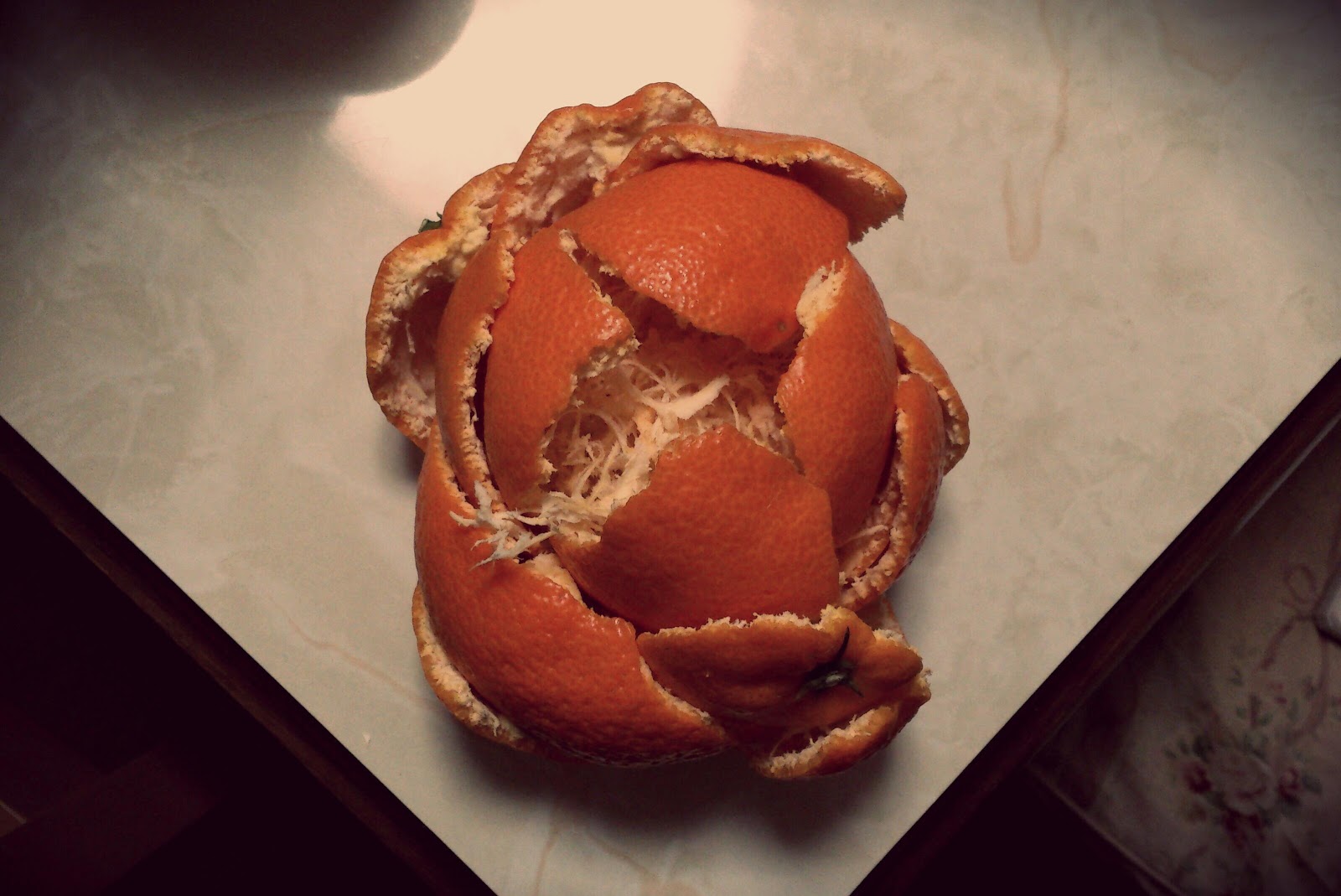
Ehime is known for their delicious mikan (mandarin oranges). We buy them by the boxes because we all love eating these mikan during the winter. Our family of six ate a total of two store bought 10kg boxes in a week. Not to mention the other mikan we ate from the trees growing in the yard (pictured above).
But I did manage to pry myself away from the box of mikan and get out and about for a bit. On the last day of the year, I was still making my nengajo and in the evening I made a mad dash to the town post office to make it in time for the mail pick-up. I took a detour around the local port before heading back home to watch the Kohaku show on TV with the family. 
Watching this NHK program has become kind of a tradition…my parents tell us stories and information about the older singers and my sister’s keep us up-to-date on who is who in the younger generation. Since I don’t have a TV in my apartment, I don’t have any information to offer so I usually just sing along with all the songs that I know. All the while eating mikan, of course 🙂
Do you have new years eve traditions? Did you watch Kohaku this year (if you’re in Japan)?

Tiny flowers growing in our yard.
I love these old wooden walls.
Not only do we eat mikan, we include them in our new years decorations, too!
Small boats just bobbin around in the water.
Notice the number four is missing.
We had amazing sunsets.
Toshi-koshi Soba and the NHK Kohaku show.
We rose extra early on new years day to see the first sunrise…isn’t it pretty? 😀

The Trip To Ehime Via Okayama

The Japanese word Kisei (帰省) means to travel back to our hometown or where our family is.
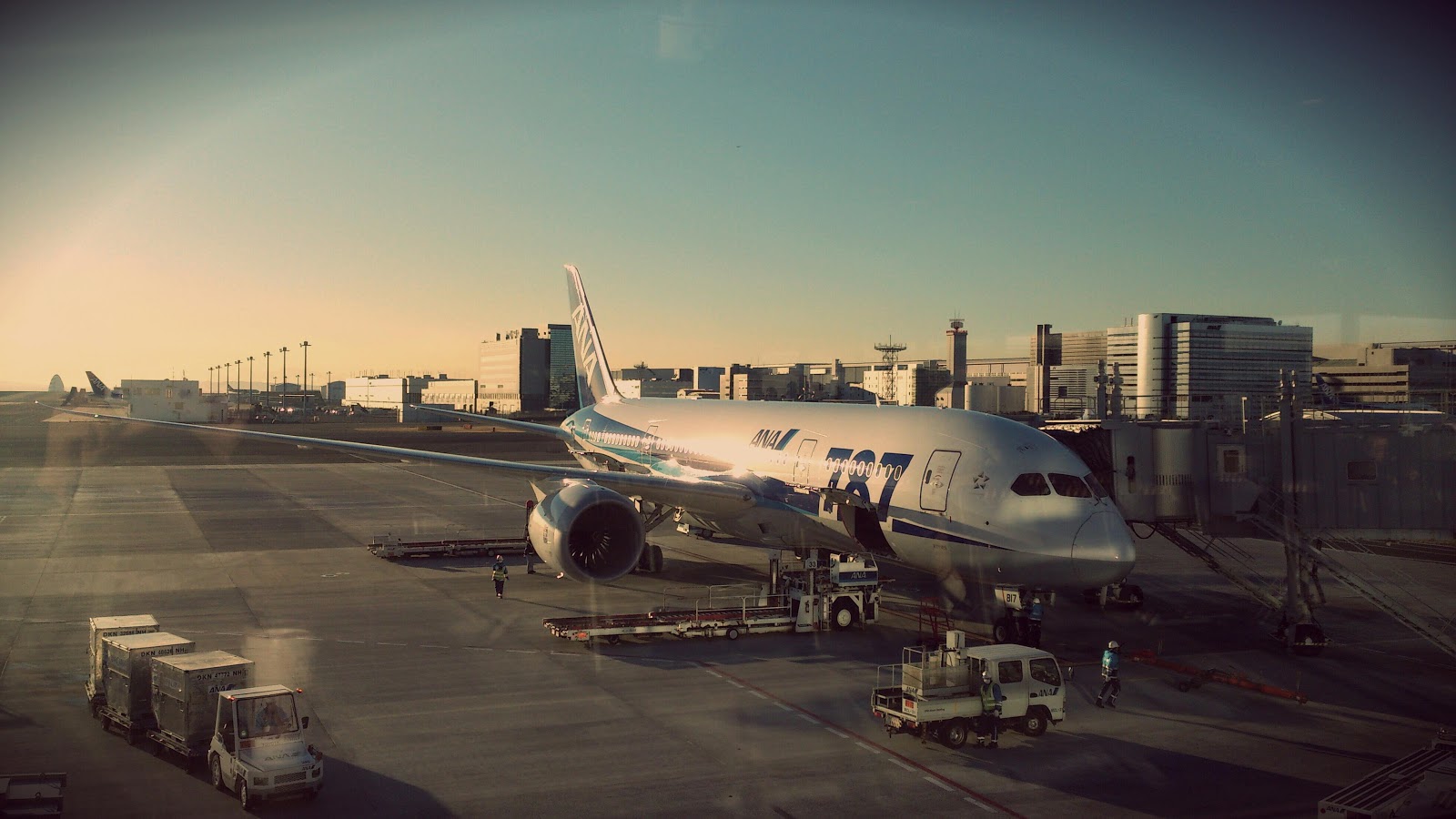
This new years holiday I traveled back home to Ehime by way of Okayama airport. Ehime prefecture actually has their own airport in Matsuyama, but because Ehime is only accessible by airplane, the tickets always sell out very quickly. So our other option is to fly into Takamatsu airport, which is in the prefecture next to Ehime and take the express train. But the express train actually goes from Ehime to Okayama and you need to change lines when coming from Takamatsu airport.
Thus my decision to fly in from Okayama airport. And lucky me, the tickets to Okayama were super cheap (apparently it has to do with the price competition between shinkansen and flights)! So my kisei this time ended up being a flight (1hr 15min), a bus ride (25min), a train ride (2hr 30min), and a short walk (15min), which I surprisingly enjoyed. Well, maybe not the bus ride. But the view from the airplane and train ride was fantastic!
For those of you who do not live in Japan, to put it simply, going to Ehime via Okayama is sort of like going to New York via Canada (with an emphasis on sort of) 😉
Here are some pictures of my kisei I took on my cellphone:
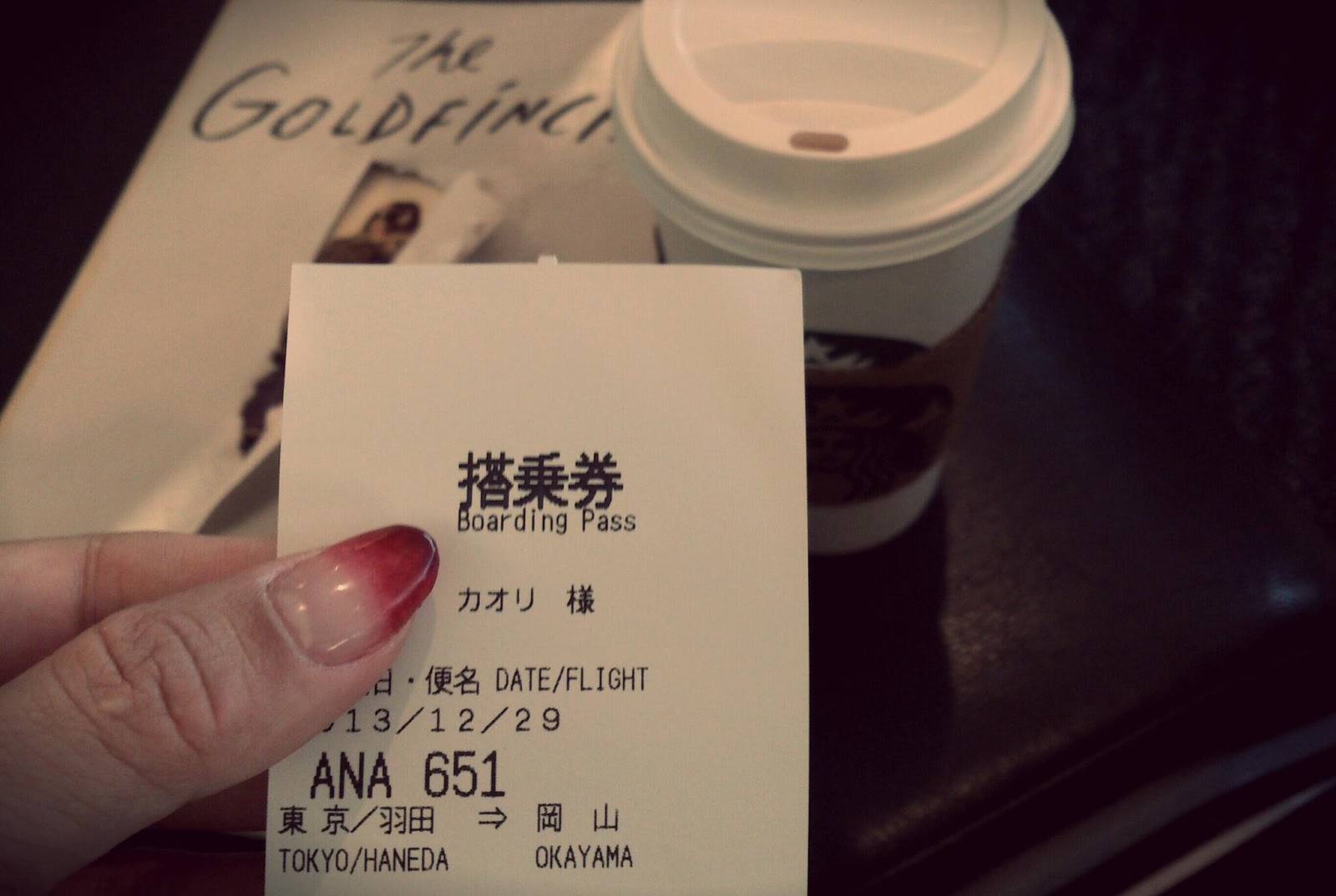
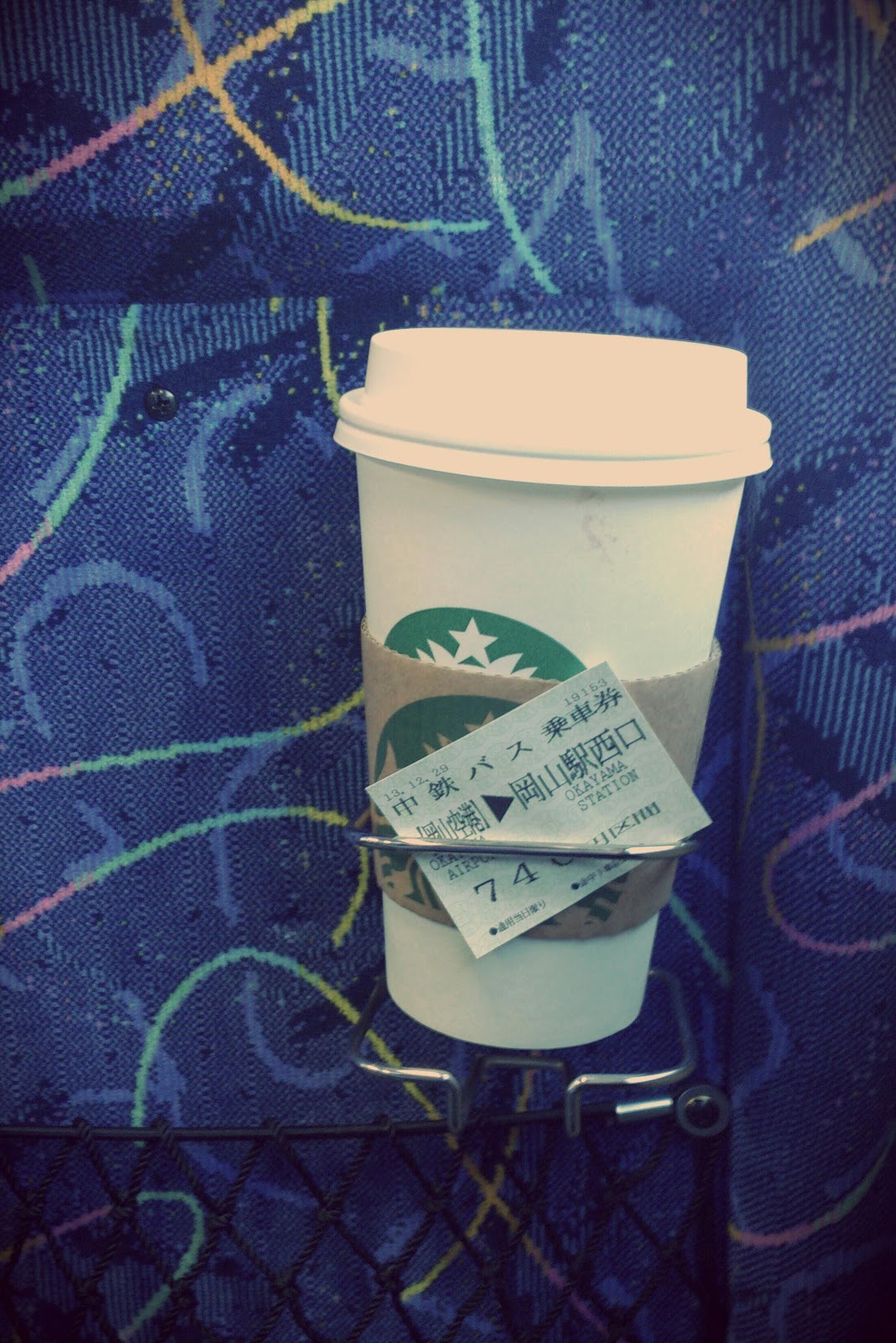
Getting ready to board with my book and mocha chai latte.
I always melt a little when I see the pilot in the cockpit wave to little kids in the airport.
In the bus from Okayama airport to Okayama station.
Okayama prefecture is famous for the folklore Momotaro.
The JR Kibi line from Okayama station…isn’t the train handsome?

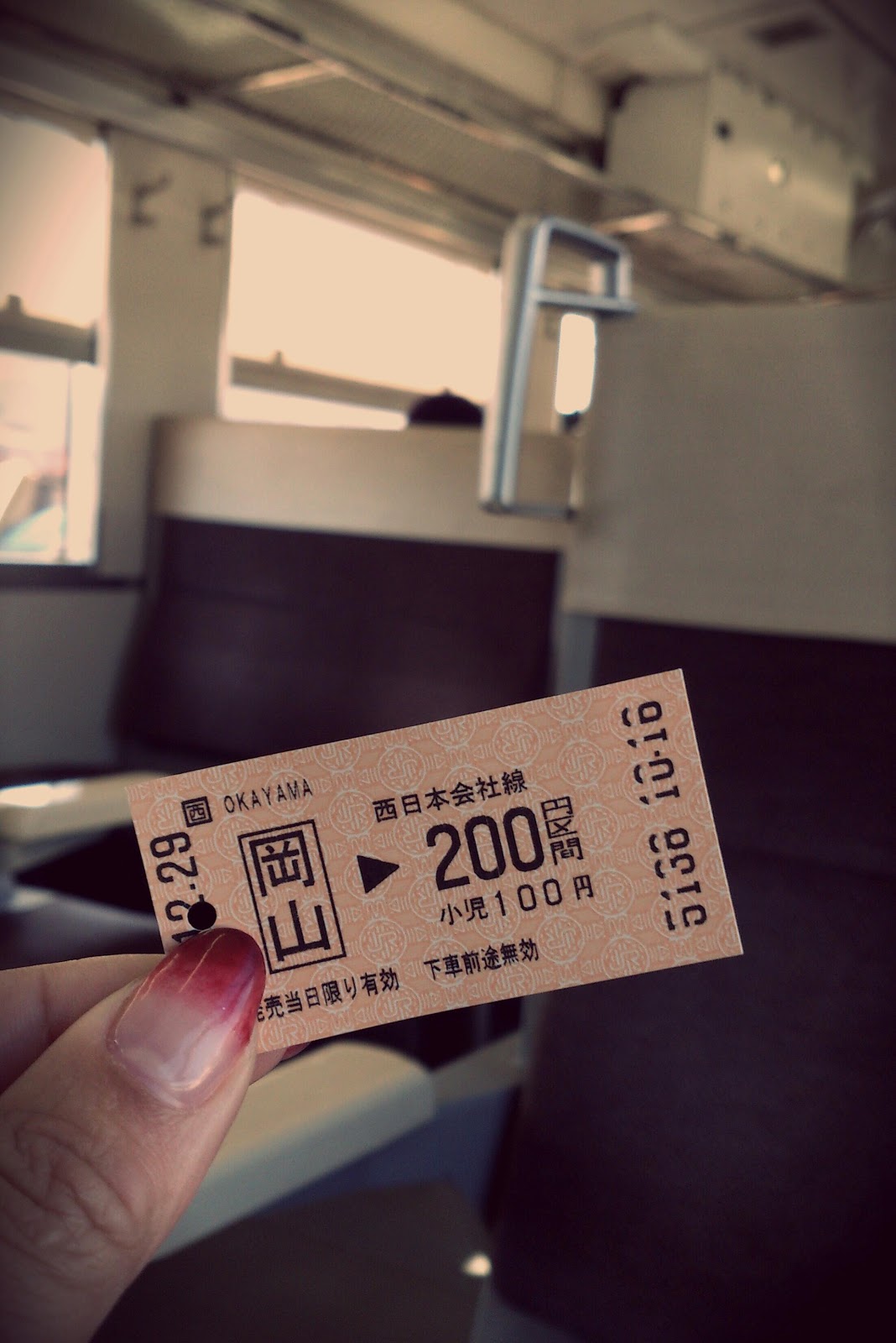
My ticket from Okayama station to Kibitsu station.
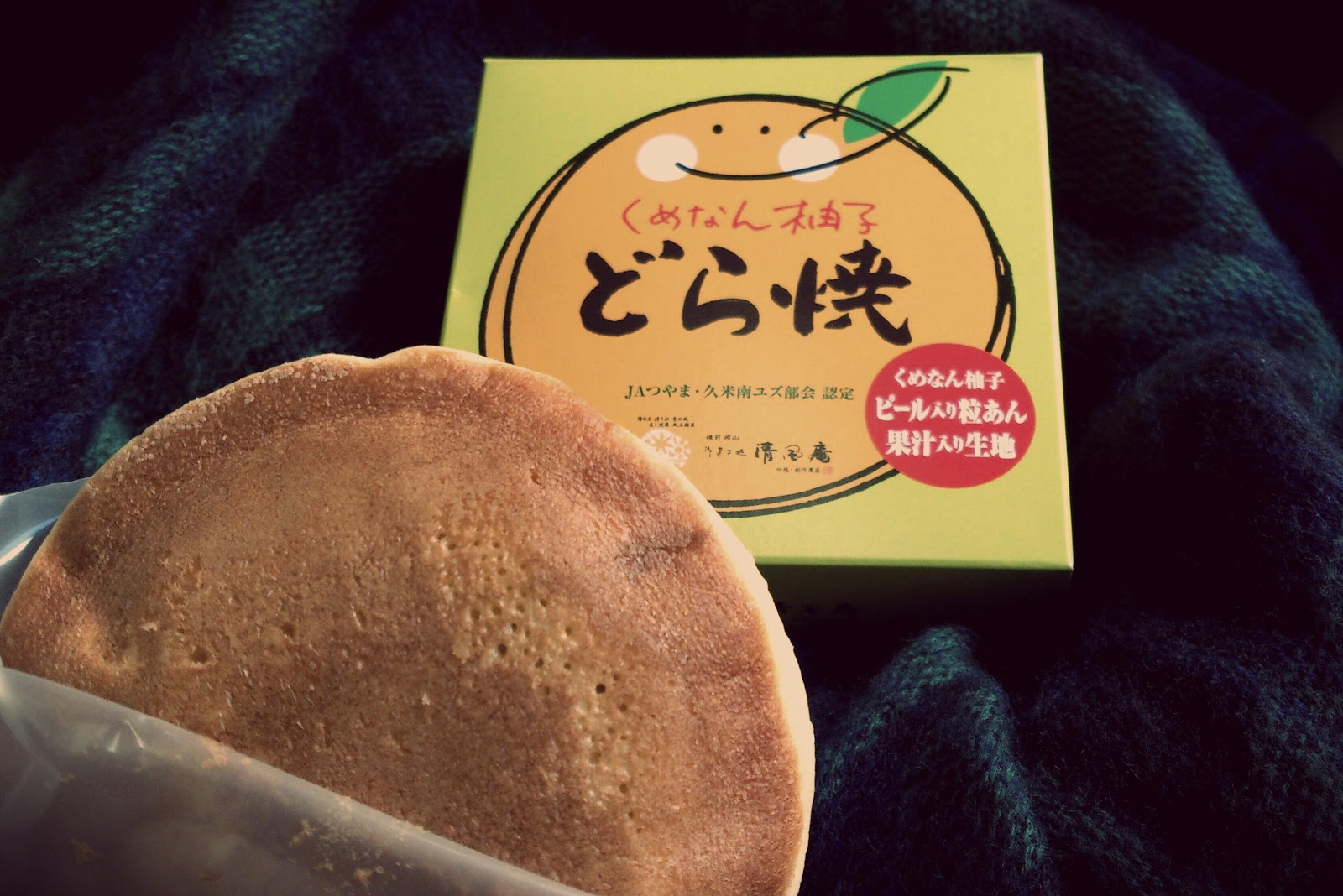
The great thing about rural lines is that you have time to snack on dorayaki during the train ride.
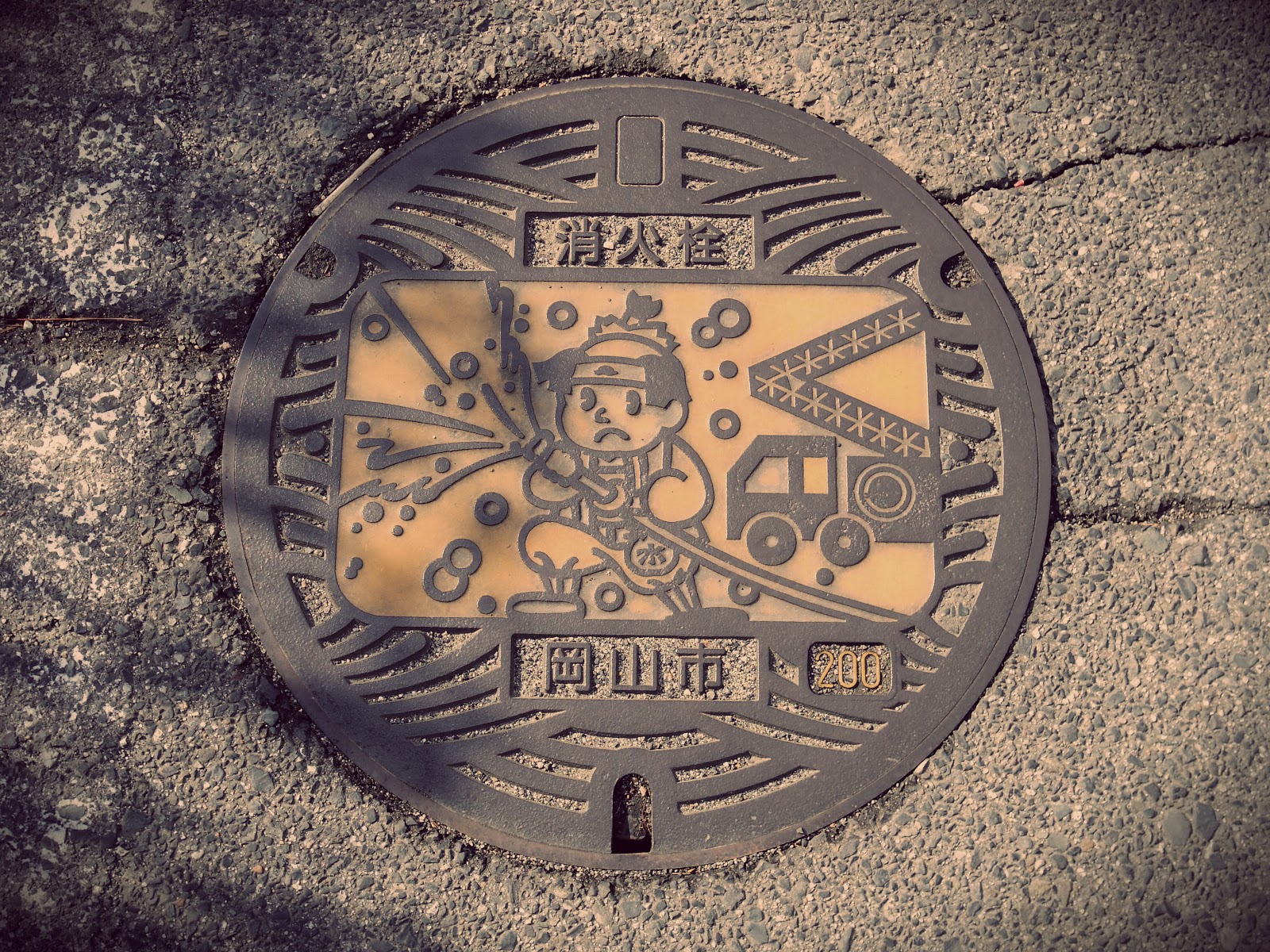
Okayama has the cutest manhole covers.
Just a short walk from Kibitsu station is Kibitsu Shrine, famous for this gorgeous corridor.
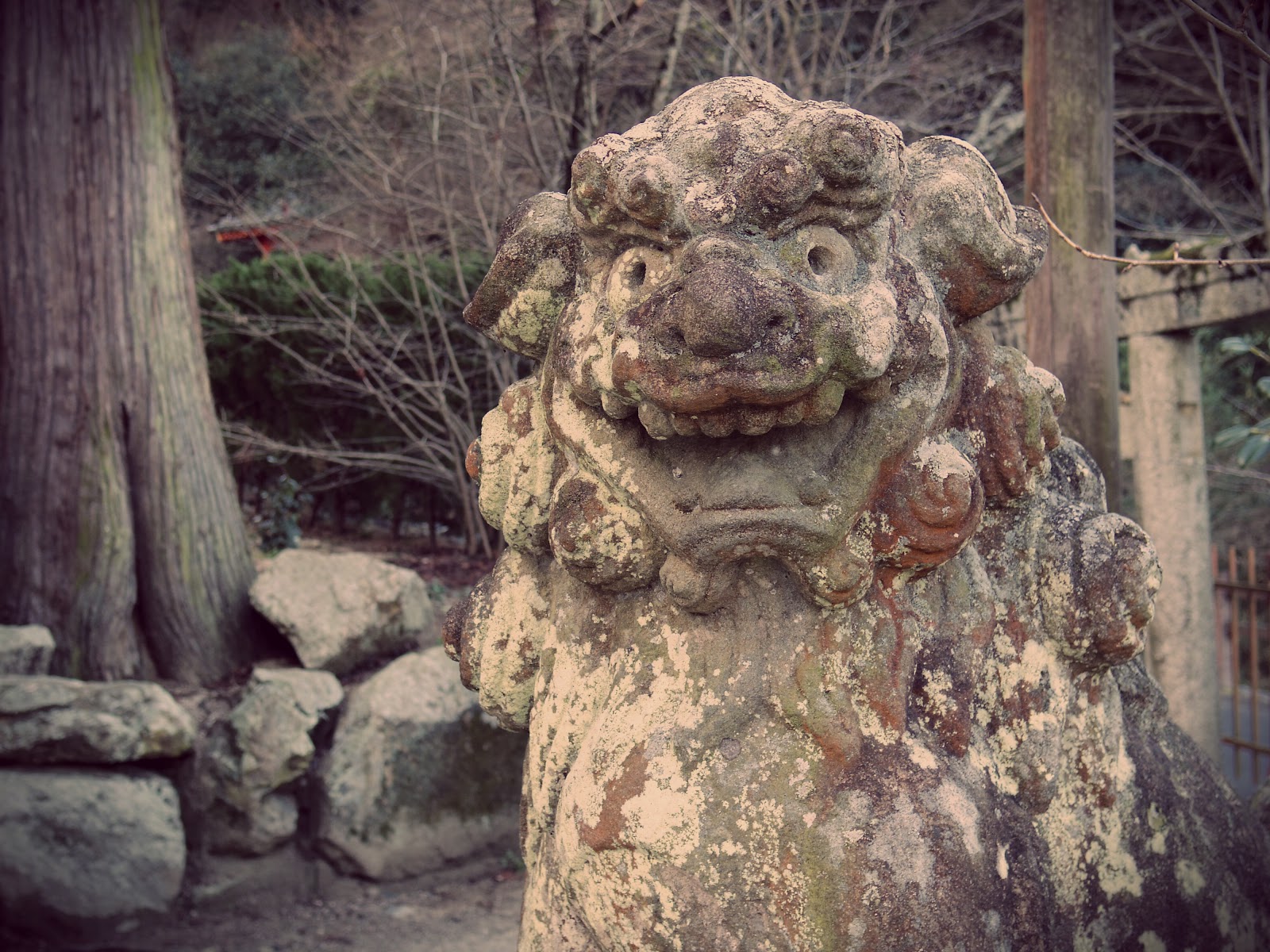
The koma-inu’s silly laugh had me giggling all the way home.
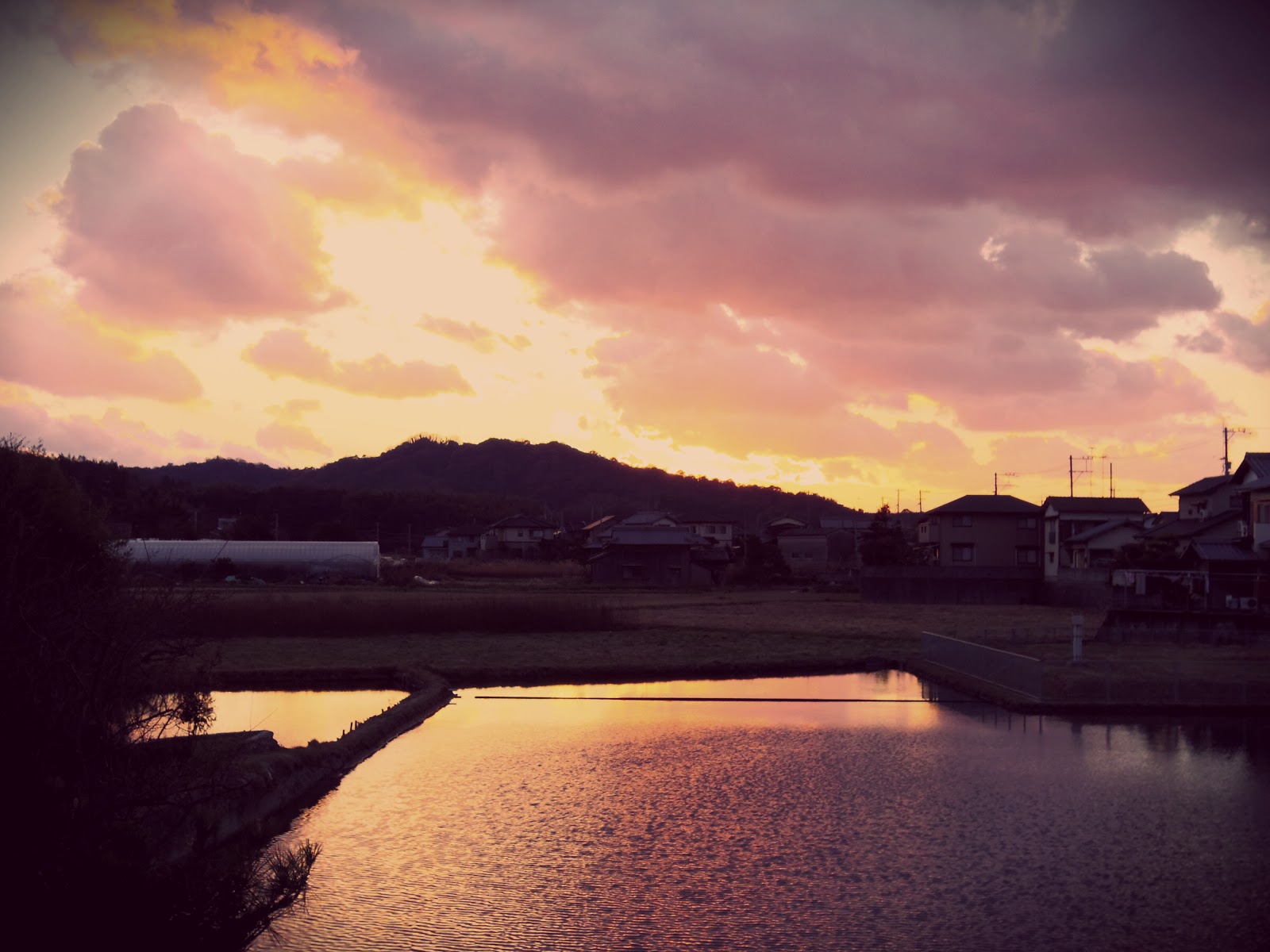
After a two and a half hour train ride, I was greeted by a lovely sunset.
You know you’re in Ehime when there is an abundance of mikan to eat…good to be home. x